Today's lessons on one screen
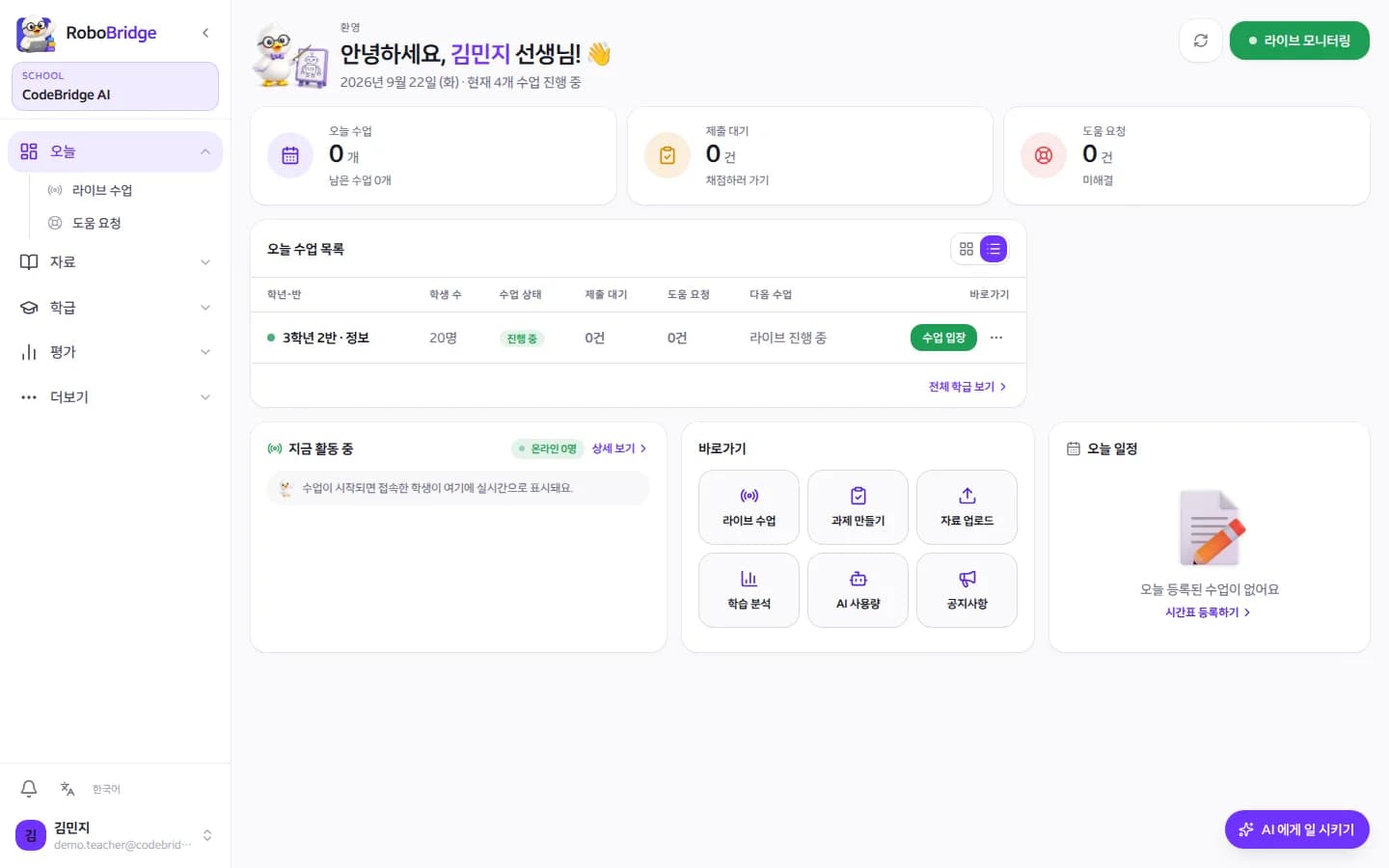
The teacher home surfaces today's classes, pending grading and help requests first.
- Today's classes with one-click entry
- Shortcuts to live monitoring, assignments and uploads
- AI usage and announcements in one place
No school onboarding · Browser only · Built for Korea's 2022 revised curriculum
RoboBridge is a K-12 informatics teaching platform that combines a 3D robot simulator, an AI tutor and classroom management in one screen. Teachers start today with a single account; thirty students each get their own robot and unlimited retries.
Preparation, delivery, assessment and records in one flow. Every image below is a real production screen.
The teacher home surfaces today's classes, pending grading and help requests first.
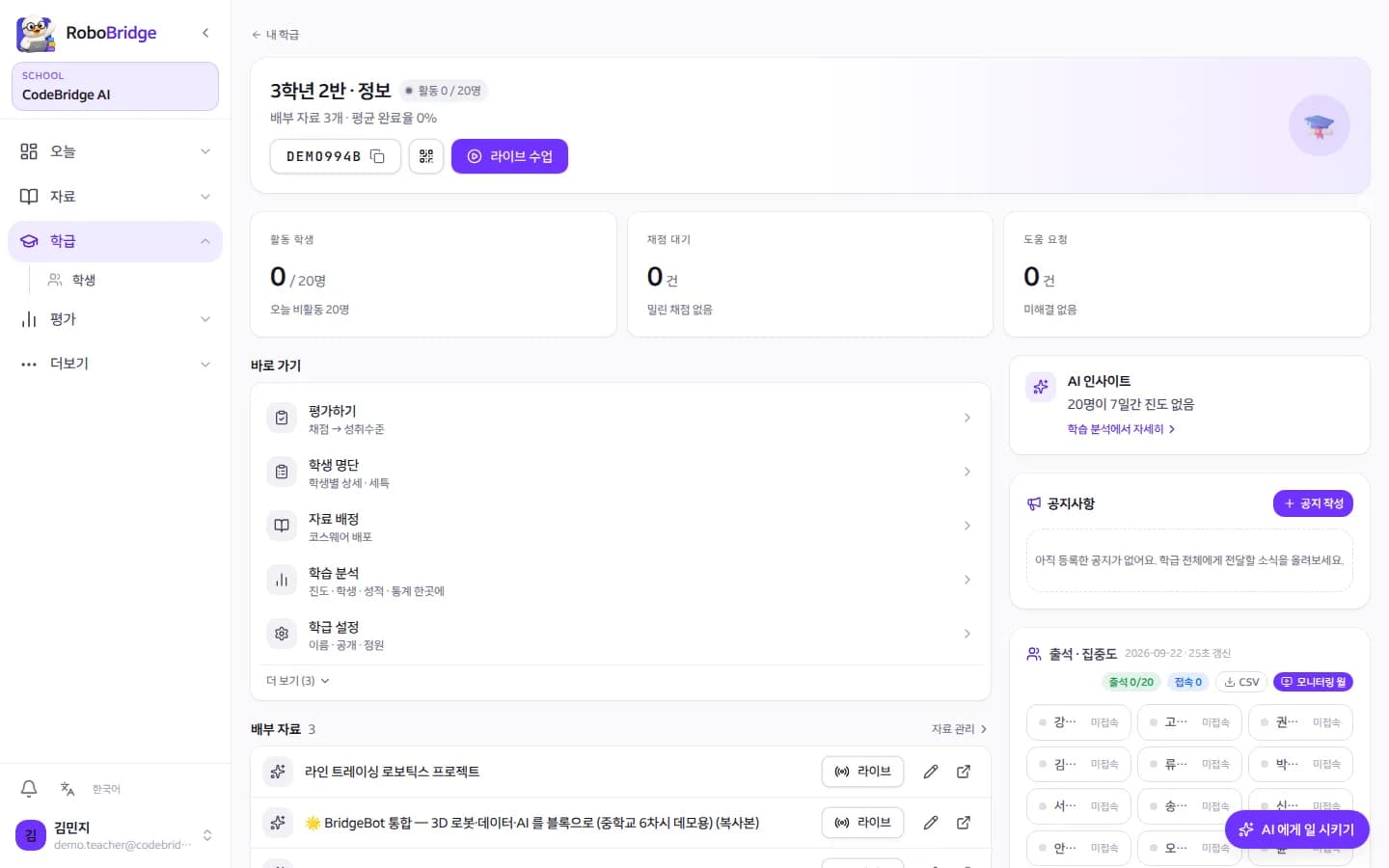
The class dashboard shows invite codes, active students, grading queue, help requests, distributed materials and attendance.
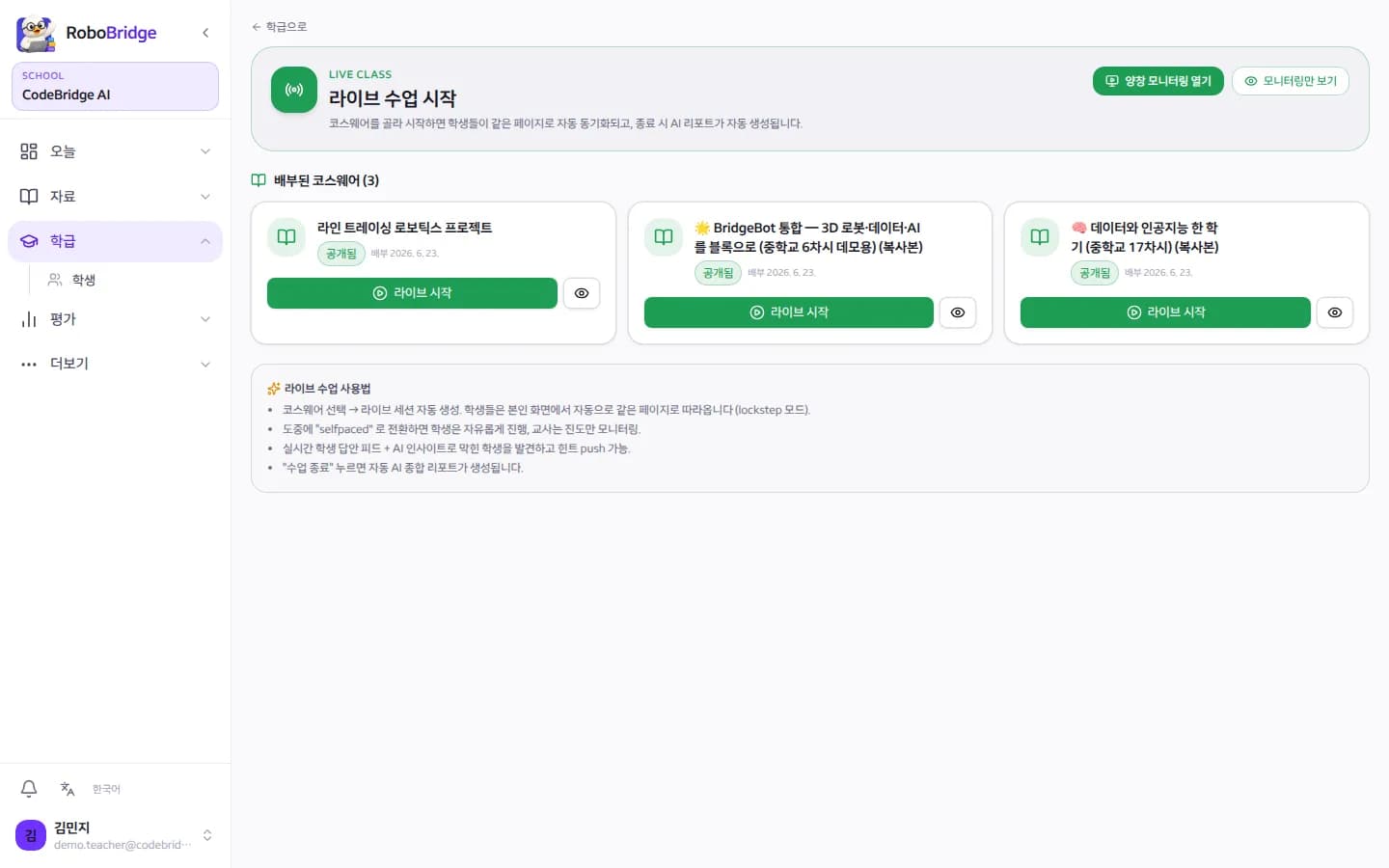
Pick a courseware and start; student screens follow the same page automatically.
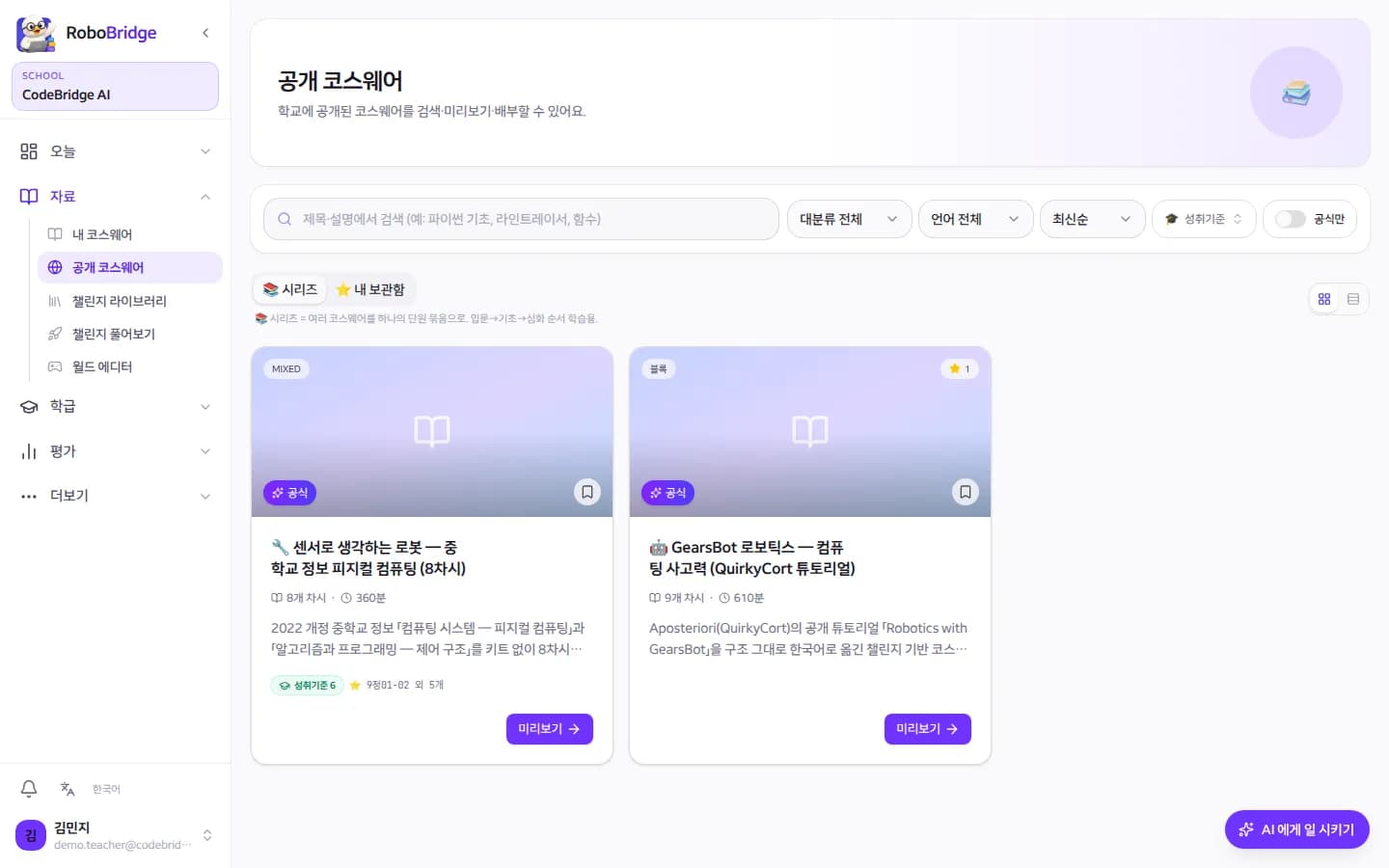
Preview standards-mapped official courseware and distribute it to a class.
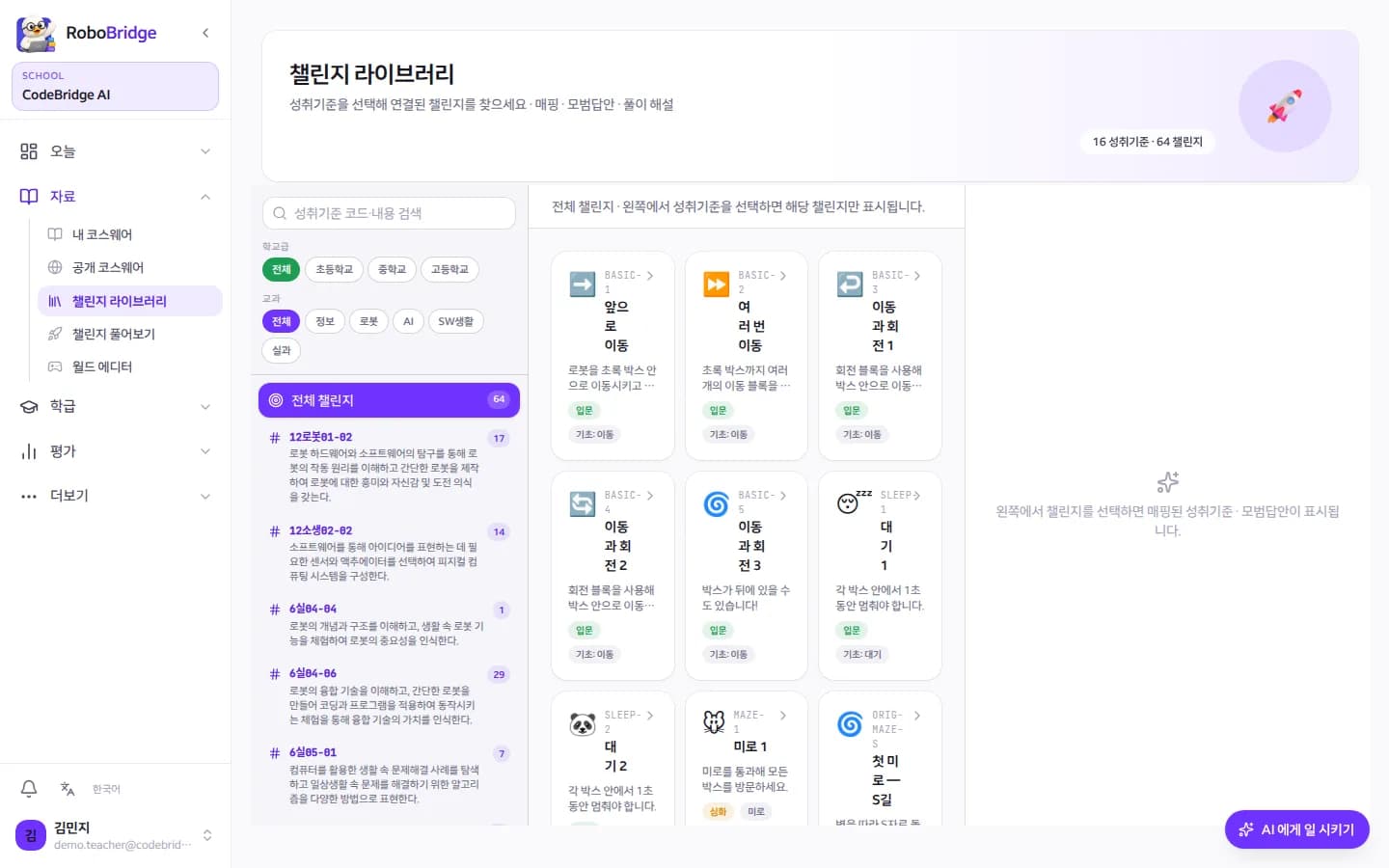
Choose a standard to see linked challenges, model solutions and teaching notes.
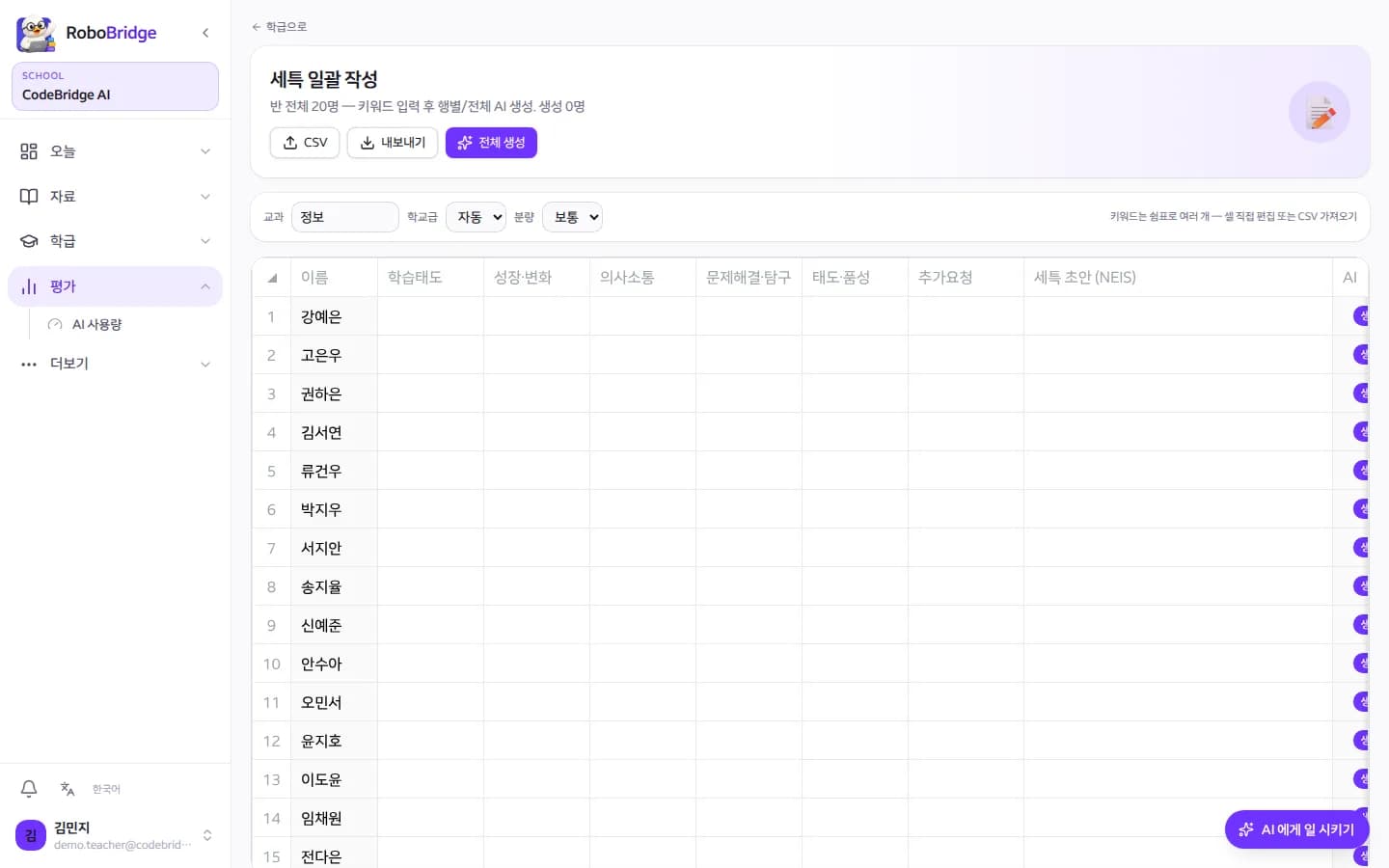
Enter evidence keywords per student and get a record draft you can edit in NEIS format.
Resume from home, retry challenges without fear, and watch growth accumulate.
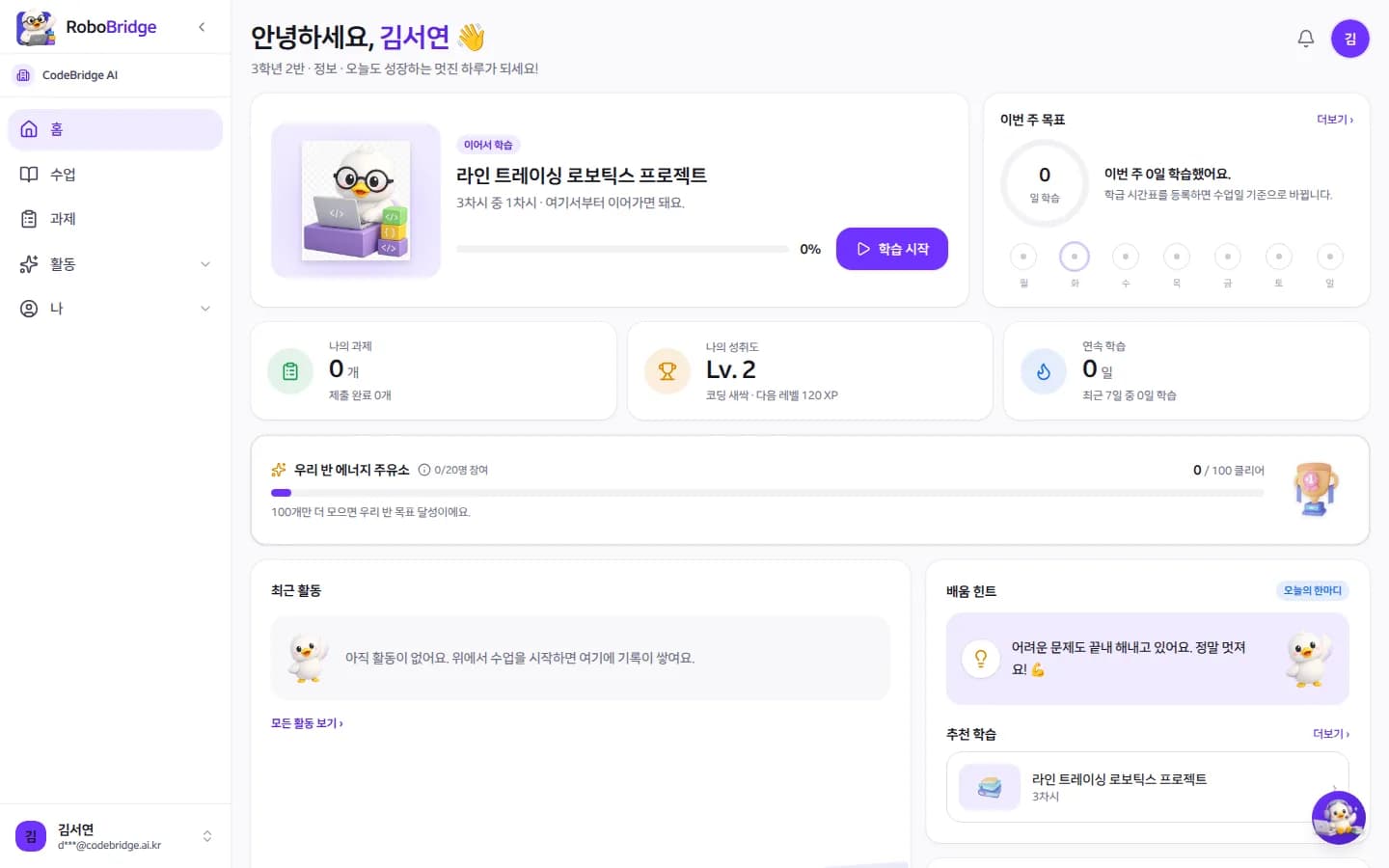
The student home puts the last lesson on top.
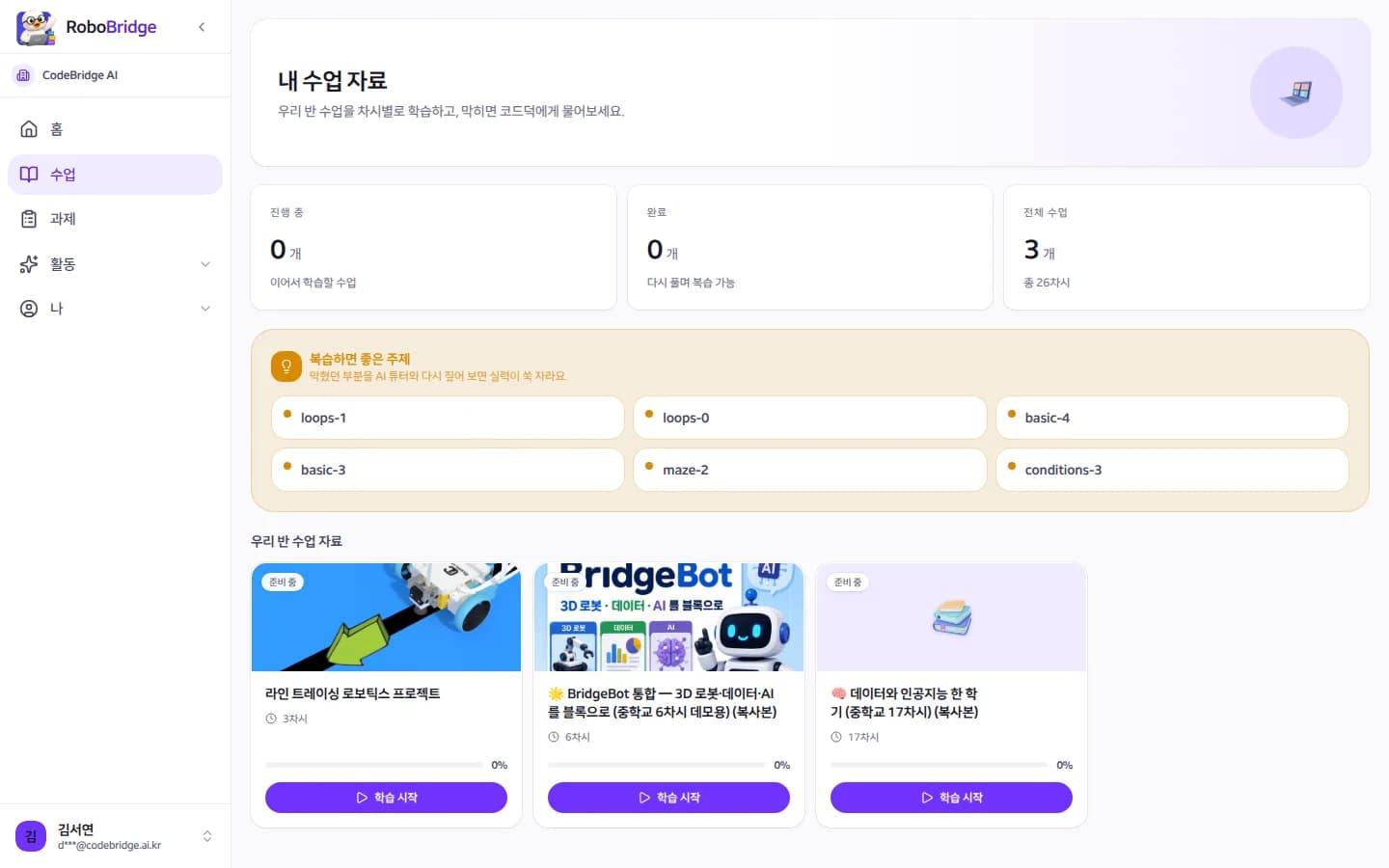
Work through assigned courseware lesson by lesson and get topics worth reviewing.
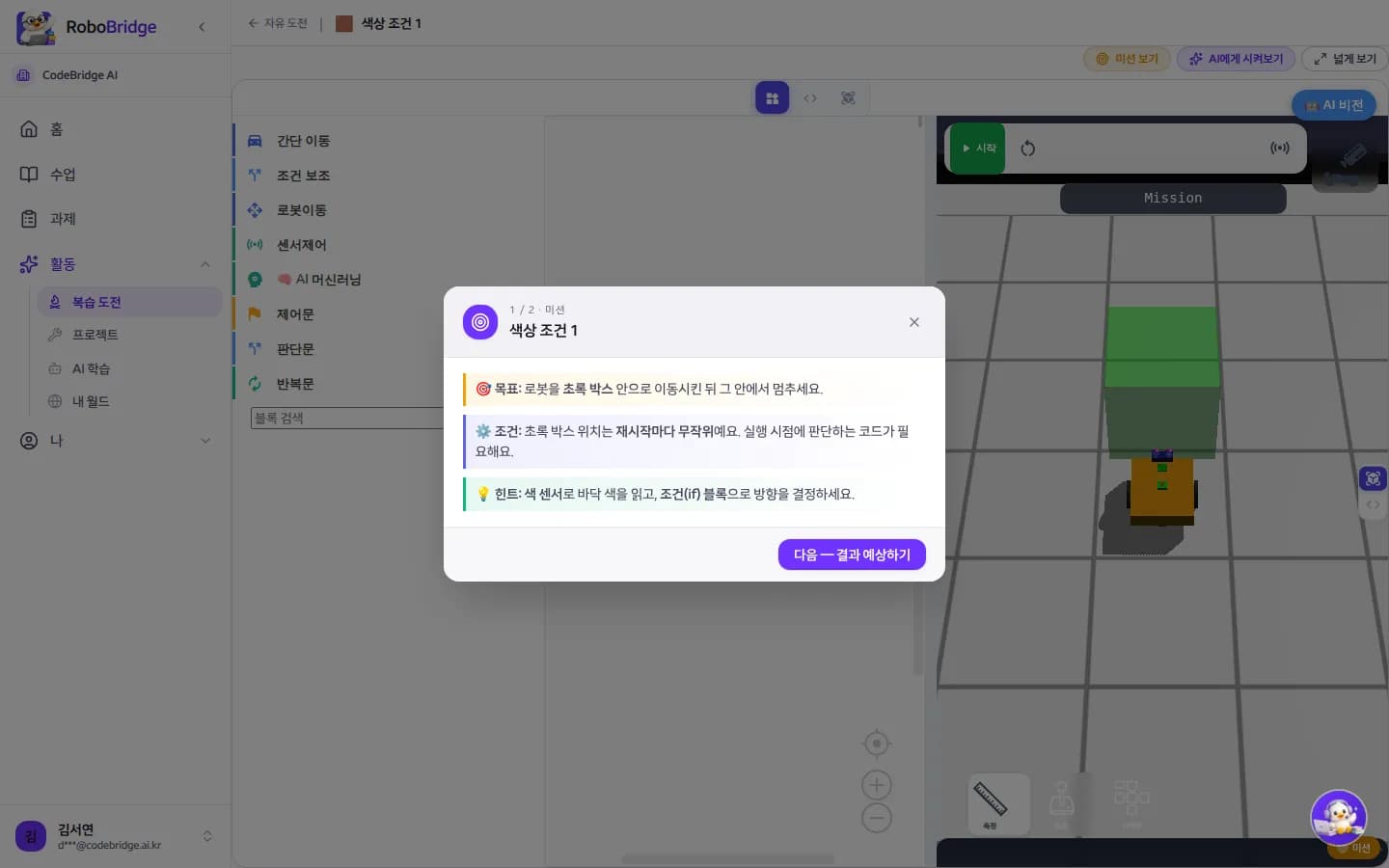
Each challenge shows goal, conditions and a hint first, then asks for a prediction before running.
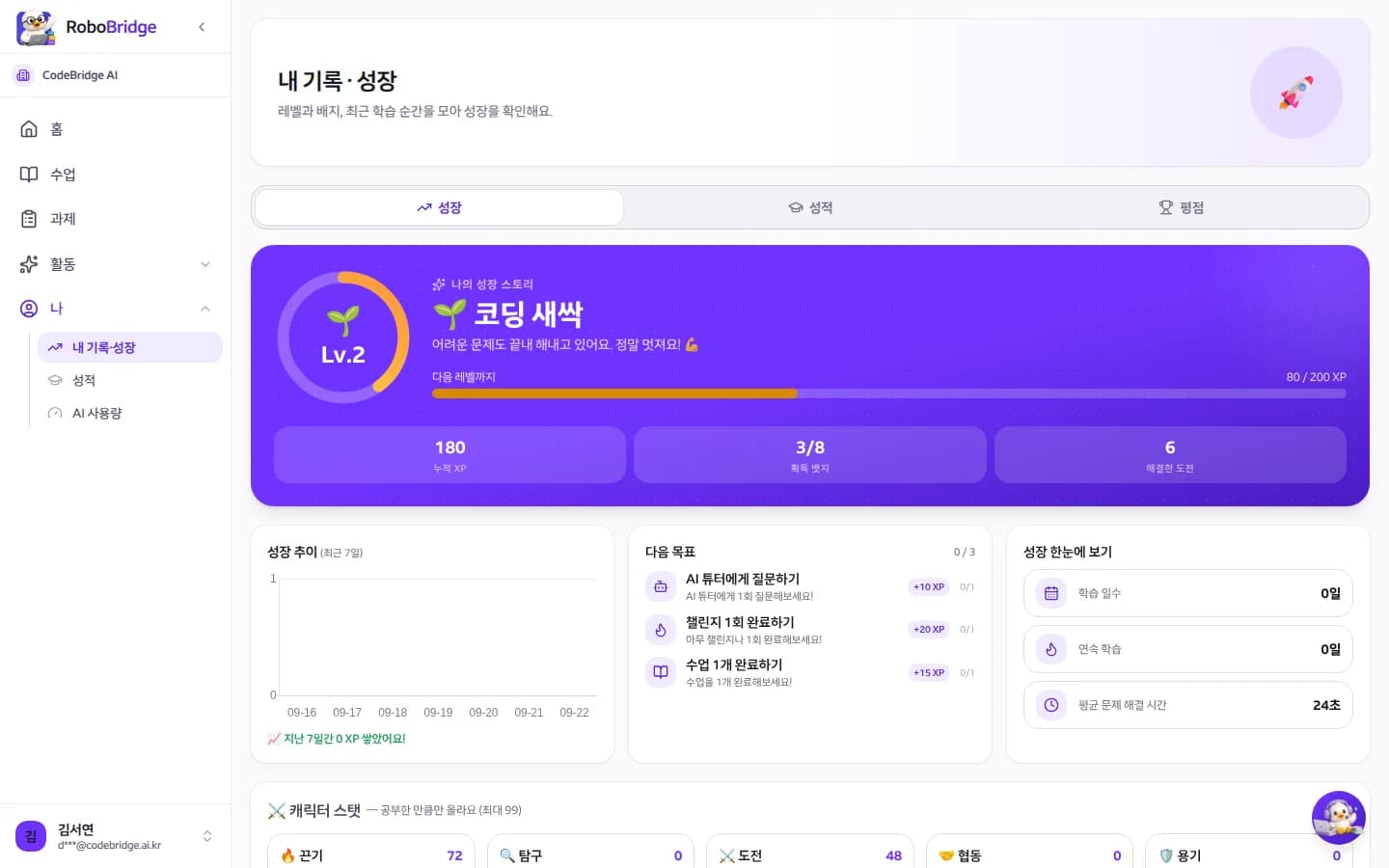
Level, badges, solved challenges and next goals in the student's own words.
Each lesson pairs a concept with a simulation or challenge, a taste of Python and a formative quiz, all linked to standards and rubrics.
8 lessons · 360 min · 6 standards · 12 challenges
Input-process-output → motors → ultrasonic → conditions → loops and line following → nested control → system design → project.
9 lessons · 610 min · 61 challenges
Decomposition, pattern recognition, abstraction and algorithm design through maze, dungeon, loop and condition challenges.
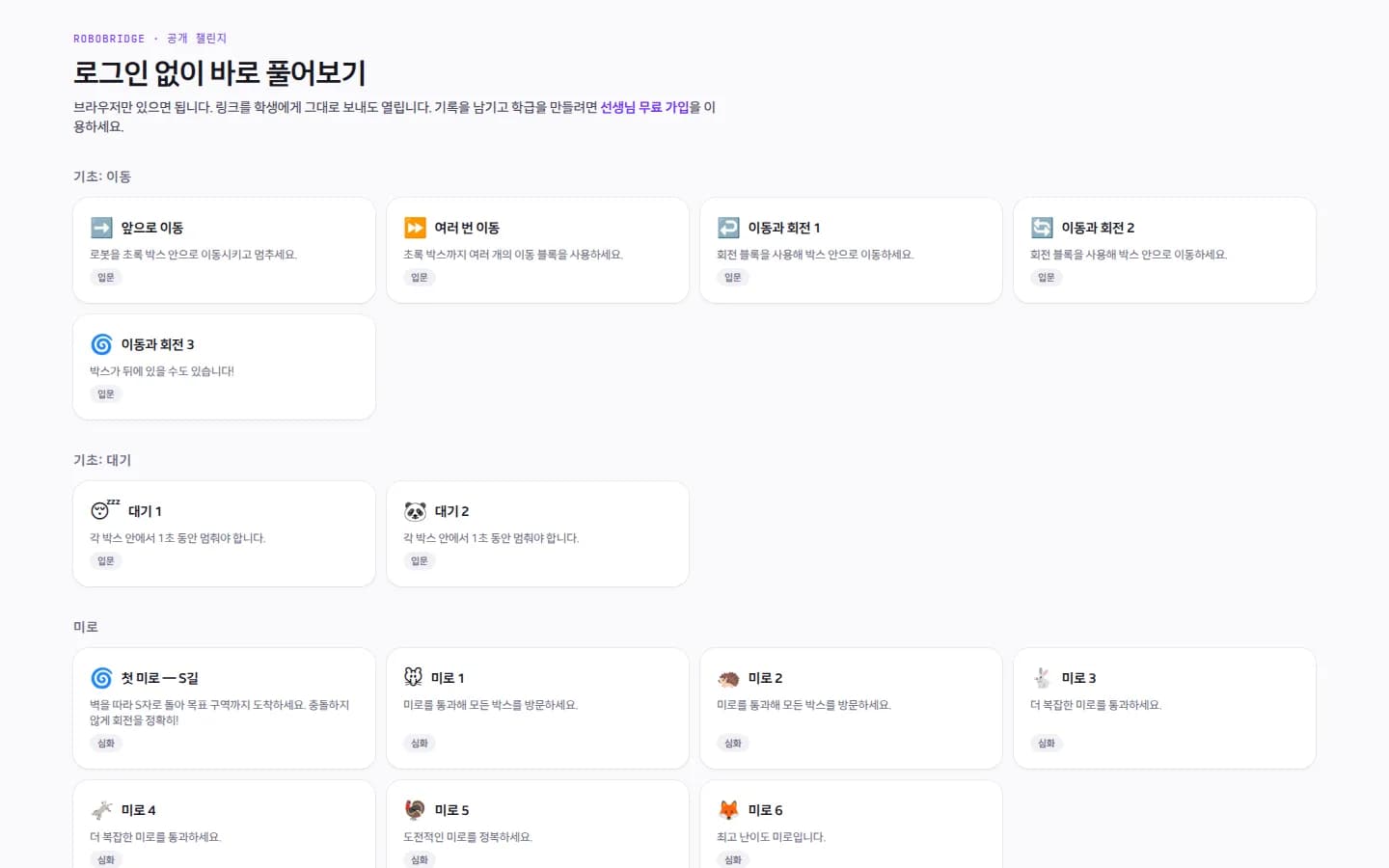
Kits still fit: practise at home in the simulator, verify at school on real hardware.
| Kit classroom | RoboBridge | |
|---|---|---|
| Practice ratio | 1:2–1:3 (groups) | 1:1 (a virtual robot per student) |
| Breakage or loss | A whole group stops | None — instant retry |
| Home practice | Kits rarely leave school | One link, anywhere |
| Evidence for standards | Teacher observes and logs by hand | Auto-mapped per lesson → record draft |
| Grading reproducibility | Varies by unit | Same code, same result |
| Non-teaching load | Batteries, storage, repairs | None |
A single teacher can start without school approval.
Email and password only. No school code, no approval.
Share an invite code or QR; students self-enrol. Chrome is all they need.
Import official courseware, distribute it and start a live lesson. Pull record drafts at term end.
Yes. The 3D simulator follows the official LEGO EV3 and Pybricks APIs, so code written here also runs on real EV3 or SPIKE hardware. Physical-computing units (sensors, actuators, control structures) run entirely kit-free.
Yes. One teacher account runs one class of 30 students free, including the simulator, challenges, public courseware, the AI tutor (daily cap) and live lesson mode.
A school license adds unlimited classes and teachers, an admin console, record drafts, AI grading and school reports. Pricing is quoted by size and we prepare public-procurement paperwork with you.
Each official lesson is mapped to middle-school informatics standards and 64 challenges are linked to 16 standards, ready to cite in lesson and assessment plans.
Teachers enter evidence keywords per student; the AI drafts a record which the teacher reviews and edits in NEIS format. It organises evidence — it does not write answers for students.
No. Coduck looks at the student's current sensor values and robot position and helps with questions and staged hints. It never hands over solution code.
Student data is stored under pseudonymous tokens on servers in Korea, isolated per school. Learning-record collection is switched on by the school administrator with consent settings.
Yes, with the same features. Start with one class and scale by headcount; contracts follow the institution type.
Five minutes to sign up, a day to the first lesson. Decide on a school license after the usage data is in.